
Client ·Oct 2026 → ongoing
Noble Link
A store for a men's jewellery business in Trinidad that sold by Instagram message: Miami Cuban chains in four widths, from the first look to an order closed, with referrals and store credit the database keeps honest, and an admin run from a phone. A prototype, not yet launched.
- Timeframe
- Oct 2026 → ongoing
- Tags
- E-commerce · sveltekit · cloudflare-d1 · referrals
- Credits
- Xern Mottley — Engineer
- The kind of build
- Ecommerce Build one like it →
Where it started
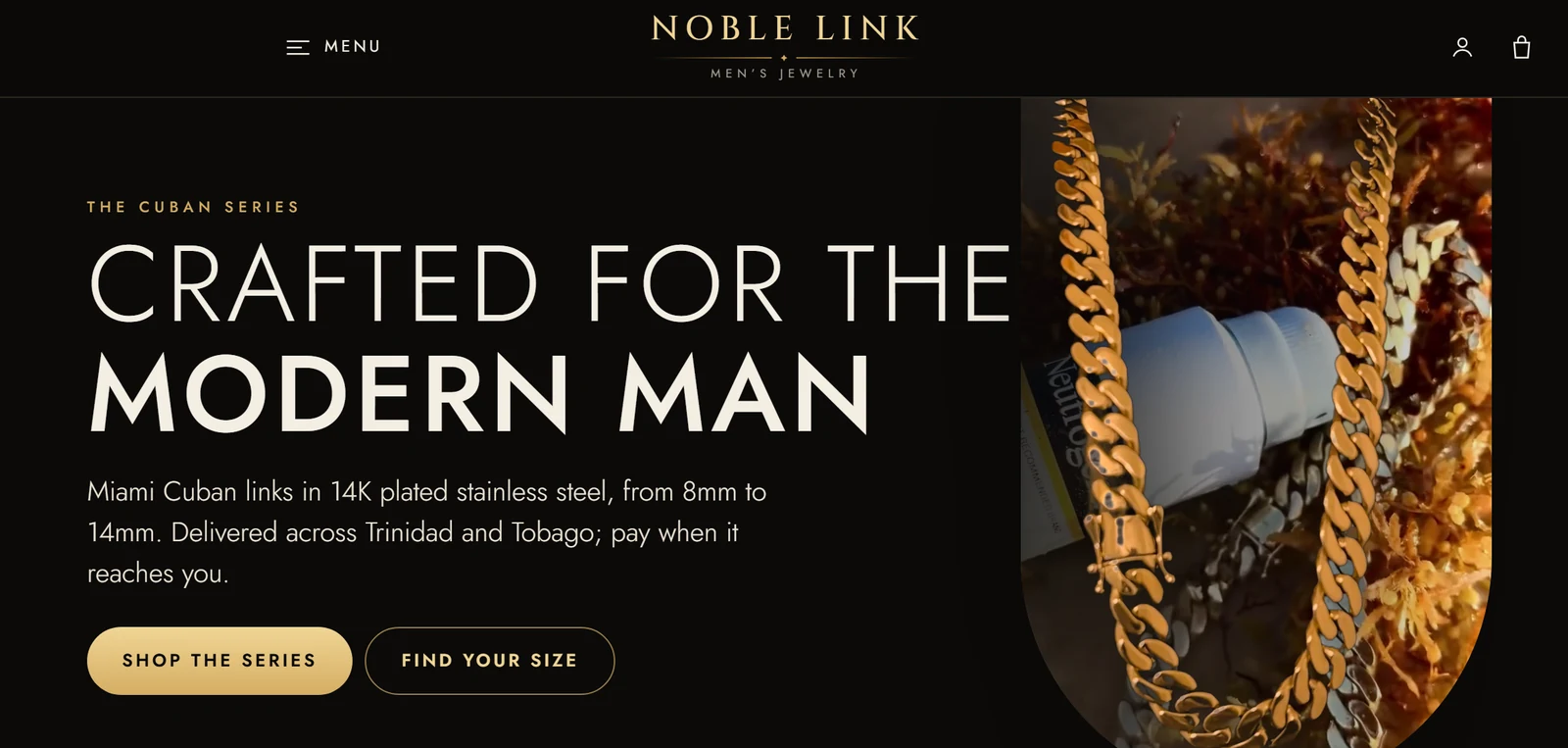
Noble Link sells men's Miami Cuban link chains in Trinidad and Tobago, in four widths and two lengths, with a bracelet and a set to match. It sold on Instagram: the price in every caption, the order by direct message.
Noble Link asked for a store. The brief, on 5 October 2026, was the whole of it: the store, delivery and payment, referrals and store credit, built for the phone first and on the photographs the business already had. Two rules shaped it the same day. No courier or payment company would be built in, and the product shown would be the product.
The whole store in one loop, from a reel on Instagram to an order closed, and a friend's link back to the start. Every stage was in the first draft.
What was done
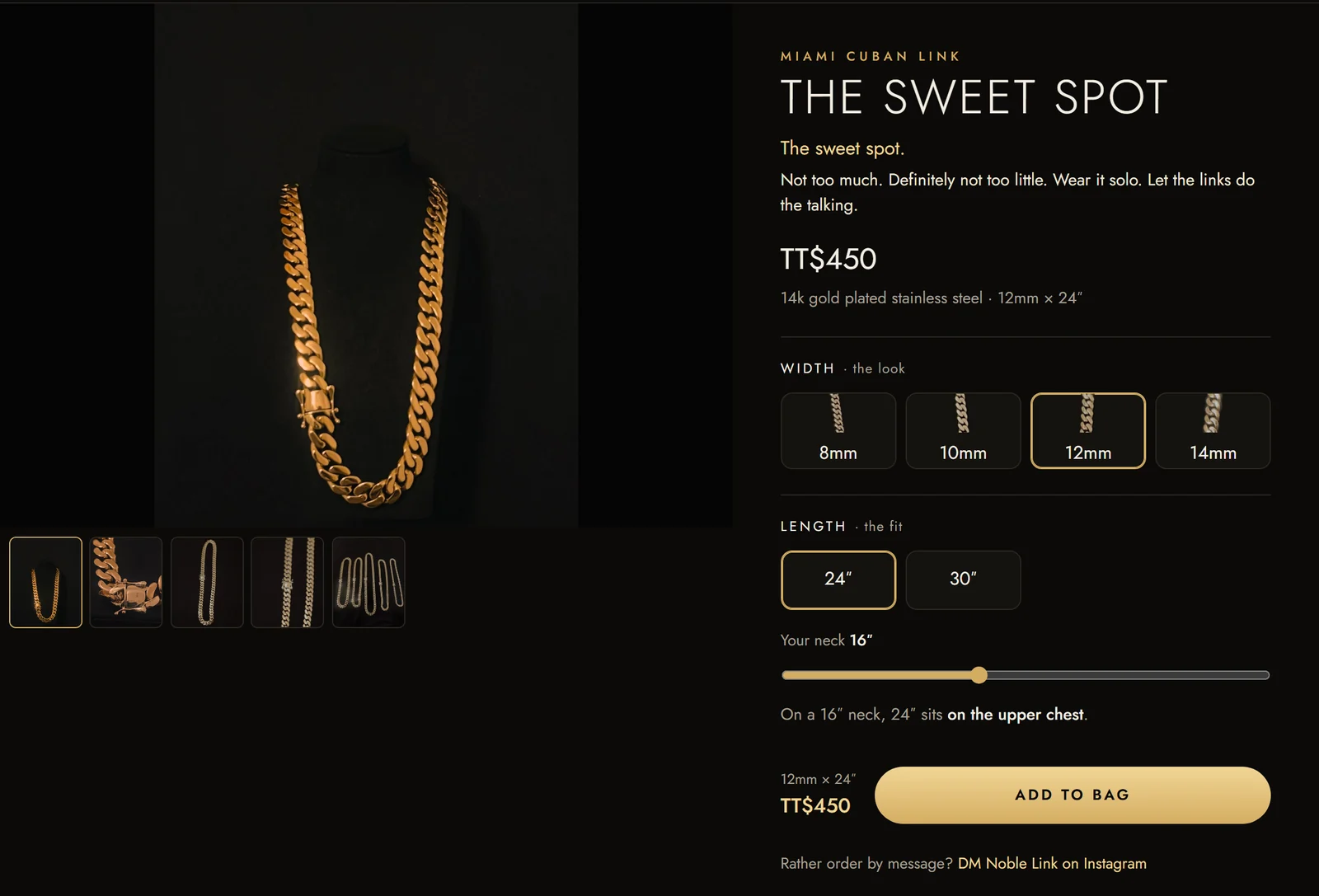
A chain's page: the piece's own photographs, width buttons drawn from each chain's own links, the fit line for a neck size, and ordering by message kept open. Noble Link's photographs and price, on the local build.
The first draft was the whole funnel: a home page on their own reel, a shop, a page for each chain, a bag that opens beside the page, one-page checkout, the order's own page, and an account with store credit and a link to share. An order taken by direct message is keyed into the same book, so its customer gets the same page.
Delivery and payment are each one interface with providers behind it: a courier's API, a driver booked by hand, or collection; payment at the door, by card on the gateway's own page, or by bank transfer. A new provider is an adapter, and an order never changes shape for it.
One interface for delivery and one for payment, the providers behind each, and where each stands. An order never names a company.
The product shown is the product. Every photograph belongs to the exact chain, width and length it shows. A chain drawn in 3D from its width and length was the first thing built, and it came off the store when it could not stand beside the photographs; generated models wearing the chains went the same way. In their place, the five chains of one photograph were cut apart by measurement, so the widths compare at their true scale.
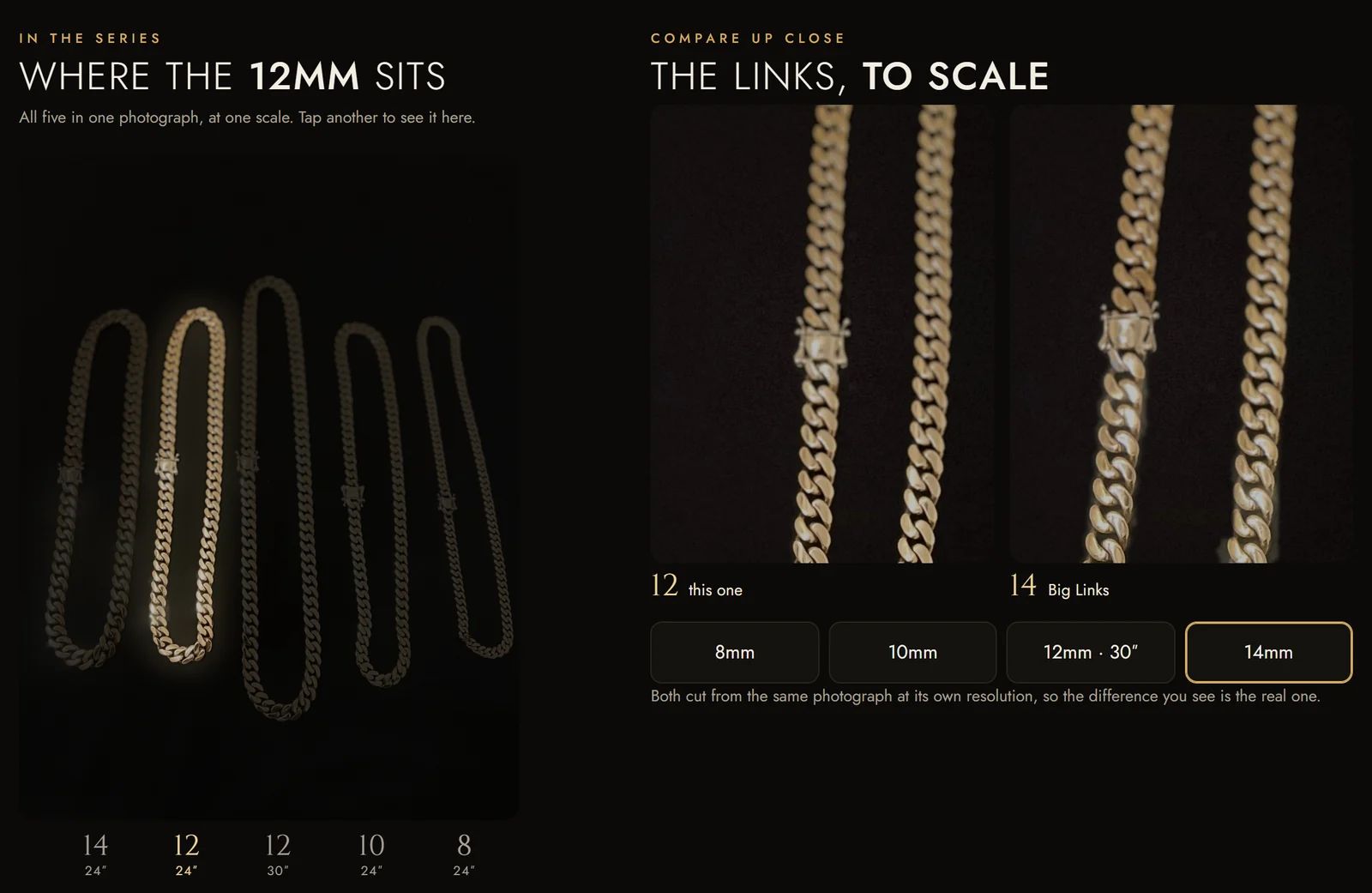
Five chains cut from one photograph by measurement: the 12mm lit in its place in the series, and two widths compared from that same photograph at its own resolution.
On 16 October the admin moved onto OPI's client admin kit: sign-in by a code, Today's list, every order with its next step, customers, referrals and the photo checks, in Noble Link's colours and built for one hand.
The decision that mattered
Referrals pay out real money, so they are the first thing someone will try to game, and store credit is the same money in another form. The question put to the first draft was how to stop people scamming the referral system, and the answer had to hold when nobody was watching.
So each referral is judged at checkout against the referrer's own orders. A friend whose phone, delivery address or device the referrer has ordered with is the referrer by another name, and is refused. Softer signs, such as two friends at one address or many in a week, hold the reward for a person to look at.
The reward itself is paid only as store credit, and only once the friend's order is delivered, paid and past the exchange window.
A referral from link to reward: refused, held for a person, or fine, judged against the referrer's own orders, with the database's own rules beneath. The amounts are Noble Link's to set.
The rules that matter most are the database's own. A referral pays each side once, however often the payout is retried, and no balance goes below zero. Reward credit lapses and never pays for a whole order, while credit from a refund is the customer's and never lapses. An order whose total does not equal its parts is refused whole.
Those rules came out of a review of OPI Tech's data model, OPI's own store, before it was reused: 45 tables became 33, and fourteen faults were fixed on the way, two of them in how credit was paid.
Where it stands
A prototype, built on 5 October at Noble Link's request and deployed the same day with a plain-language guide to the whole store. It has not launched. Card payments, the store's policies and its own domain are still to do, and the courier connects once Noble Link holds a merchant account.
Five October, in the order it was decided: from the brief to a deployed prototype in a day, with two things built and taken off because they were not the piece. Then the admin, onto OPI's kit.
Messages are planned and not built: order updates on WhatsApp and by email, one reminder for a basket left behind, and word when a sold-out chain is back. The captures here come from the store on this machine, with Noble Link's own photographs.
Next — The Myracle Boutique →